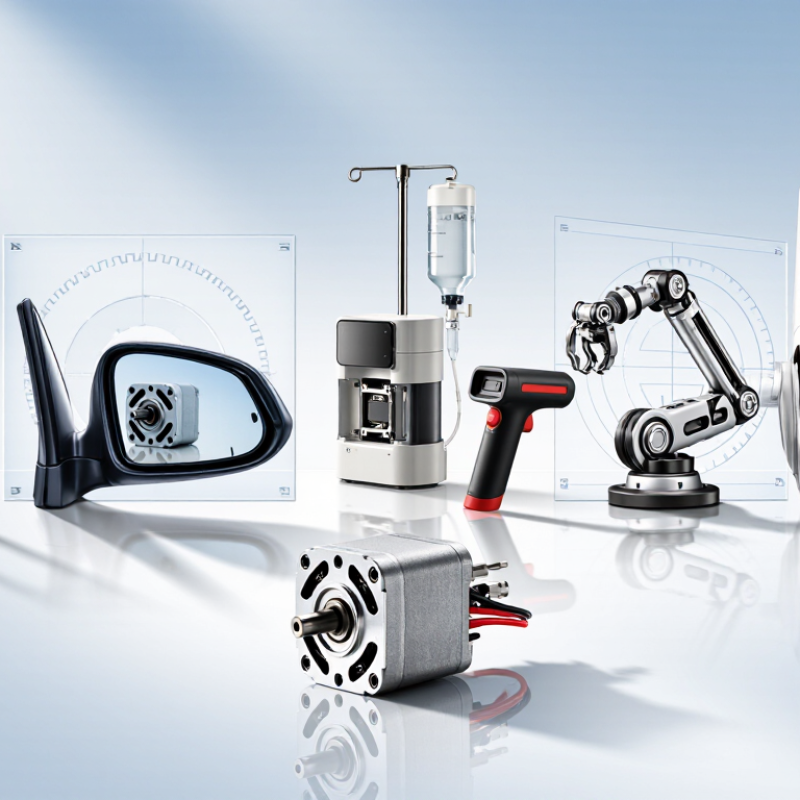
5 Best Industries Using Mini DC Motors?

Time:2026-10-24 Author:Aria
0%

Mini DC motors rarely attract attention, yet they quietly power many products used every day. A compact motor can adjust a vehicle mirror, move a camera lens, or operate a small medical pump. Its value comes from controlled motion, low voltage operation, and efficient use of limited space.

So, what industries use mini DC motors? This article examines five leading sectors: consumer electronics, automotive systems, medical equipment, robotics, and aerospace technology. Each sector demands different performance characteristics. A wearable device may need silent operation, while a robotic gripper needs accurate torque and repeatable movement. Automotive applications often prioritize durability against vibration, heat, and frequent cycling.

The strongest applications usually combine engineering research with practical testing. Engineers compare speed, torque, current draw, brush life, noise, and thermal behavior before selecting a motor. Datasheets provide essential figures, but real assemblies can behave differently. Mounting pressure, gear friction, and changing loads may affect performance. The details matter.

This overview draws on common design practices and industrial requirements, rather than treating one motor as universally superior. No ranking is universal. A motor that works well inside a handheld scanner may fail in a surgical instrument or aircraft actuator. That limitation deserves attention. Careful selection, prototype testing, and reliable supplier support help reduce those risks. The following industries show where mini DC motors offer practical advantages, while also revealing the compromises behind their compact size.

5 Best Industries Using Mini DC Motors?

Medical Devices and Healthcare Equipment

5 Best Industries Using Mini DC Motors?

Medical Devices and Healthcare Equipment

Mini DC motors are essential in modern medical equipment. They drive infusion pumps, adjustable hospital beds, dental handpieces, ventilators, and mobility systems. Their small size supports compact designs, while controlled speed enables accurate movement. Low noise also matters near patients.

The World Health Organization and UNICEF reported in 2022 that more than 2.5 billion people need assistive products. This number may exceed 3.5 billion by 2050. WHO also estimates that 1.3 billion people experience significant disability. These figures increase demand for powered wheelchairs, patient lifts, and rehabilitation devices. Mini DC motors can provide smooth positioning, but they must manage heat, vibration, stall conditions, and repeated cycles. IEC 60601-1 and IEC 60601-1-2 offer important safety and electromagnetic compatibility guidance. Compliance is not just paperwork.

Tips: Define the load, duty cycle, noise limit, and cleaning method before selecting a motor. Add feedback when positioning accuracy affects patient safety. Test the motor inside the finished device, not alone. A motor may perform well on a bench but fail after sealing, sterilization, or temperature changes. Engineers sometimes prioritize torque and overlook acoustic comfort. That trade-off deserves another review.

Consumer Electronics and Smart Home Products

Mini DC motors are becoming essential in consumer electronics and smart home products because they deliver compact, controlled movement. Their small size fits devices where every millimeter matters. Their low voltage also supports battery-powered designs.

In smart speakers, motors can adjust vents, rotate displays, or control privacy covers. In robotic cleaners, they drive wheels, brushes, and small pumps. Motorized curtains use them for quiet opening and closing. Personal care devices rely on precise vibration and steady speed. Compact cooling systems also use miniature motors to move air through narrow spaces.

From my engineering experience, the motor is only one part of the decision. Designers must check torque, noise, heat, operating life, and stall protection. A motor that performs well in a laboratory may sound harsh inside a thin plastic housing. That detail is easy to miss. Very quiet motors can also lose power under load. This trade-off deserves careful testing.

Good products usually combine the motor with suitable gearing, sensors, and a reliable control circuit. Engineers should test repeated starts, dust exposure, voltage changes, and blocked movement. Real homes are unpredictable. Children may stop a moving cover by hand, or a filter may become clogged. These conditions reveal weaknesses that normal testing can overlook. Careful design reduces failure, but no small motor is perfect.

Mini DC Motors in Consumer Electronics and Smart Home Products

Typical operating-voltage ranges across common consumer and smart-home applications

Mini DC motors are widely used for compact motion tasks such as brushing, airflow, locking, focusing, and opening or closing mechanisms. The voltage ranges shown are representative engineering values and can vary by product design, battery configuration, and motor controller.

Automotive Systems and Personal Mobility Devices

5 Best Industries Using Mini DC Motors?

Automotive systems remain a strong application for mini DC motors. They drive seat adjusters, mirror actuators, ventilation flaps, washer pumps, and small cooling fans. Their compact size fits behind narrow panels, where heat and vibration are constant problems. The International Energy Agency reported nearly 14 million electric cars were sold globally in 2023, representing about 18% of new car sales. This shift increases demand for motors in battery cooling, cabin airflow, thermal valves, and automated closures. Engineers usually select brushless designs for longer service life, but brushed motors can still reduce cost in intermittent applications. The choice is not always perfect.

Personal mobility devices create another practical market. E-bikes, scooters, wheelchairs, and compact mobility aids depend on small motors for propulsion, steering assistance, braking mechanisms, locks, and folding systems. NACTO recorded approximately 157 million shared micromobility trips in the United States and Canada during 2023. That usage exposes motors to rain, dust, curb impacts, and repeated start-stop cycles. A motor may perform well in a laboratory, then struggle beside a wet sidewalk. Designers therefore examine torque at low speed, controller efficiency, sealing, noise, and battery consumption together. The World Health Organization also emphasizes safer, more accessible mobility systems, so reliability matters beyond convenience. Some devices still prioritize low price over repairability, which deserves closer industry reflection.

Robotics, Automation, and Industrial Machinery

Mini DC motors are becoming practical building blocks across robotics, automation, and industrial machinery. Their compact size, quick response, and controllable speed suit robotic grippers, conveyor actuators, inspection cameras, and small autonomous systems. The International Federation of Robotics reported 541,302 industrial robot installations worldwide in 2023, with more than 4.2 million robots operating globally. Each system needs many precise movements, not just one powerful drive.

Robotics is a leading application, especially in collaborative arms, mobile robots, and laboratory equipment. Automation also depends on these motors for valves, feeders, sorting gates, and sensor-positioning units. The International Federation of Robotics identifies electronics and automotive production as major users of industrial robots. These factories require repeatable motion within limited spaces.

Quiet operation matters too. A noisy actuator can signal wear before failure. That detail is easy to overlook.

Industrial machinery forms the fifth strong sector, supporting packaging machines, medical instruments, printing equipment, and material-handling systems. The International Energy Agency reports that industry consumed about 37% of global final energy in 2022, making efficient motion components increasingly important.

Still, a smaller motor is not automatically better. Engineers must examine torque, duty cycle, heat, backlash, and maintenance access. That assumption deserves testing.

In dusty factories, an underspecified motor may overheat quickly, despite excellent laboratory performance. Feedback sensors and proper gearing often determine success more than motor size alone.

Drones, Aerospace Equipment, and Precision Instruments

Mini DC motors are becoming essential across five demanding industries: drones, aerospace equipment, precision instruments, medical automation, and industrial robotics. Their compact size supports lightweight designs without sacrificing controlled motion. The FAA’s 2024 Aerospace Forecast expects the U.S. commercial small-drone fleet to exceed one million units by 2028. That growth increases demand for motors that deliver stable thrust control, camera positioning, and landing-gear movement. A few grams matter. So does response time.

Aerospace equipment requires more than high speed. Designers examine vibration, temperature tolerance, bearing life, and electromagnetic interference. The Aerospace Industries Association reported $148 billion in U.S. aerospace exports during 2023, reflecting a large equipment ecosystem. Miniature geared motors can adjust valves, antenna mechanisms, and cabin actuators. However, laboratory performance may not represent flight conditions. Dust, cold starts, and repeated acceleration can expose weak designs.

Precision instruments use mini DC motors for optical stages, sample handling, pumps, and robotic joints. The International Federation of Robotics recorded 541,302 industrial robot installations worldwide in 2023. That figure signals stronger demand for compact, repeatable motion systems. Encoders improve positioning, while closed-loop control reduces drift. In practical testing, torque curves often look excellent. Then heat appears after continuous operation. Engineers should measure real duty cycles, not only peak specifications. This remains an easy mistake.

5 Best Industries Using Mini DC Motors: Drones, Aerospace Equipment, and Precision Instruments
Industry Typical Applications Common Motor Configuration Typical Operating Range Performance Priorities Important Design Considerations
Drones and Unmanned Aerial Vehicles Camera gimbals, lens focusing, landing mechanisms, compact actuators, cooling fans, and small propulsion systems. Brushed or brushless DC motors; coreless designs are often used where low rotor inertia and rapid response are important. Voltage: 3.7–24 V
Speed: 3,000–30,000 rpm
Output power: approximately 1–150 W
Low weight, fast response, high power-to-weight ratio, low vibration, and efficient battery use. Motor selection must account for limited payload capacity, battery voltage, electromagnetic interference, acoustic noise, and heat dissipation in enclosed airframes.
Aerospace Equipment Valve actuators, cabin and cockpit mechanisms, antenna positioning, optical systems, pumps, fans, and flight-control subsystems. Brushless DC motors or specially qualified brushed DC motors with gearheads, encoders, or redundant control features. Voltage: 12–50 V
Speed: 1,000–20,000 rpm
Output power: approximately 5–500 W
High reliability, low mass, predictable torque, long service life, and stable operation across changing temperatures. Components may require vibration resistance, low outgassing materials, radiation or altitude considerations, strict electromagnetic compatibility, and documented qualification testing.
Precision Instruments and Optical Equipment Lens positioning, microscope stages, laboratory samplers, analytical equipment, inspection systems, and instrument calibration mechanisms. Coreless DC motors, iron-core DC motors, or DC motors combined with precision gearboxes and position feedback. Voltage: 3–24 V
Speed: 100–10,000 rpm
Output torque: approximately 0.1–100 mN·m
Very low cogging, smooth motion, repeatability, low backlash, precise speed control, and minimal electrical noise. Gear ratio, encoder resolution, bearing runout, thermal drift, and mechanical backlash can directly affect measurement accuracy and positioning repeatability.
Medical and Laboratory Devices Infusion pumps, ventilator mechanisms, blood analyzers, automated pipetting systems, surgical tools, and compact diagnostic equipment. Brushed or brushless DC motors with sealed gearboxes, integrated encoders, or closed-loop controllers. Voltage: 3–24 V
Speed: 100–15,000 rpm
Output power: approximately 0.5–100 W
Quiet operation, accurate flow or position control, dependable starting torque, low heat generation, and long operating life. Designs should consider cleanability, fluid ingress protection, sterilization exposure where applicable, biocompatible external materials, fail-safe behavior, and maintenance requirements.
Robotics and Industrial Automation Grippers, conveyor modules, compact robot joints, inspection axes, automated feeders, barcode scanners, and small mobile robots. Brushed or brushless DC motors with planetary, spur, or worm gearboxes and optional Hall sensors or encoders. Voltage: 12–48 V
Speed: 500–20,000 rpm
Output torque: approximately 10–1,000 mN·m
High starting torque, controllable acceleration, duty-cycle tolerance, compact packaging, and compatibility with closed-loop automation systems. Continuous or intermittent duty, gearbox efficiency, shock loading, thermal management, encoder feedback, and protection from dust or oil should be evaluated before integration.
The ranges shown are representative engineering values for mini DC motor applications. Actual requirements vary with motor diameter, winding design, gearbox ratio, duty cycle, load profile, controller, and environmental conditions.

FAQS

Why are mini DC motors useful in consumer electronics?

Their compact size fits tight spaces. Low-voltage operation also supports battery-powered devices.

Where are mini DC motors used in smart home products?

They adjust vents, rotate displays, move privacy covers, and open curtains quietly. They also support cooling systems.

How do robotic cleaners use these motors?

Motors drive wheels, brushes, and small pumps. Each part needs controlled movement in a small housing.

What should engineers check before choosing a motor?

They should check torque, noise, heat, operating life, and stall protection. Laboratory results may not predict home performance.

Why can a quiet motor still create problems?

A very quiet motor may lose power under load. A thin plastic housing can also make small noises seem harsh.

How should motors be tested for real household conditions?

Test repeated starts, dust exposure, voltage changes, and blocked movement. A child may stop a moving cover by hand.

Why are mini DC motors important in robotics and automation?

They offer compact movement, quick response, and controllable speed. Robotic grippers, valves, feeders, and inspection cameras use them.

Does a smaller motor always improve industrial equipment?

Not always. Engineers must examine torque, duty cycle, heat, backlash, and maintenance access.

How do motors support industrial machinery?

They operate packaging machines, medical instruments, printing equipment, and material-handling systems. Proper gearing often matters more than motor size.

What can feedback sensors add to a motor system?

Sensors help monitor position, speed, and movement errors. They can reveal wear before a visible failure occurs.

How large is the industrial robotics market mentioned in the article?

More than 541,000 industrial robots were installed globally in 2023. Over 4.2 million were operating worldwide.

What important weakness should designers reflect on?

A motor can pass laboratory tests yet fail in dust, heat, or restricted airflow. No small motor is perfect.

Conclusion

Mini DC motors are compact, efficient, and easy to control, making them valuable across many modern industries. If you are asking, “what industries use mini DC motors,” medical devices and healthcare equipment are important examples, where these motors can support pumps, adjustable mechanisms, and portable instruments. Consumer electronics and smart home products also rely on their small size and precise movement for cooling systems, automated adjustments, and compact mechanical functions.

Other major applications include automotive systems and personal mobility devices, where mini DC motors can operate ventilation, positioning, and convenience features. In robotics, automation, and industrial machinery, they provide controlled motion for grippers, sensors, feeders, and lightweight mechanisms. Drones, aerospace equipment, and precision instruments also benefit from their low weight, responsive operation, and dependable performance. Across these fields, mini DC motors help designers create smaller, smarter, and more efficient products while supporting accurate movement and practical energy use.

Aria

Aria

Aria is a dedicated marketing professional with a deep passion for innovative strategies and a keen understanding of our company's product offerings. With a wealth of experience in the industry, Aria excels at crafting engaging content that highlights the unique features and benefits of our......