Battery-powered products are entering homes, factories, vehicles, and medical environments at remarkable speed. The IEA’s Global EV Outlook 2025 reports that electric car sales exceeded 17 million in 2024, representing more than 20% of global new-car sales. It also records electric-vehicle battery demand above 1 TWh that year. These figures reveal a practical challenge: compact battery systems must deliver useful motion without wasting limited energy. This is where how to choose motors for battery powered devices becomes an engineering decision, not a purchasing shortcut.
A suitable motor must match torque, speed, voltage, duty cycle, noise, size, and thermal limits. Brushless DC motors often support efficient, quiet operation, while brushed motors can reduce control complexity and initial cost. Gearboxes may increase output torque, but they also add friction, weight, and maintenance points. The U.S. Department of Energy’s motor-system research consistently highlights the importance of considering the complete drive system, rather than judging motor efficiency alone. IEC 60034-30-1 also provides recognized efficiency classifications for many rotating electrical machines.
Real testing still matters.
A spreadsheet cannot predict every startup surge, jammed mechanism, or cold-weather slowdown. Engineers should measure stall current, loaded efficiency, winding temperature, and battery runtime using the intended controller. I have seen apparently powerful motors fail because their gearboxes overheated inside sealed housings. That uncomfortable detail is easy to miss. This guide examines the selection process through practical calculations, supplier documentation, prototype testing, and lifecycle thinking. It also questions common assumptions, because the smallest motor is not always the most efficient choice.
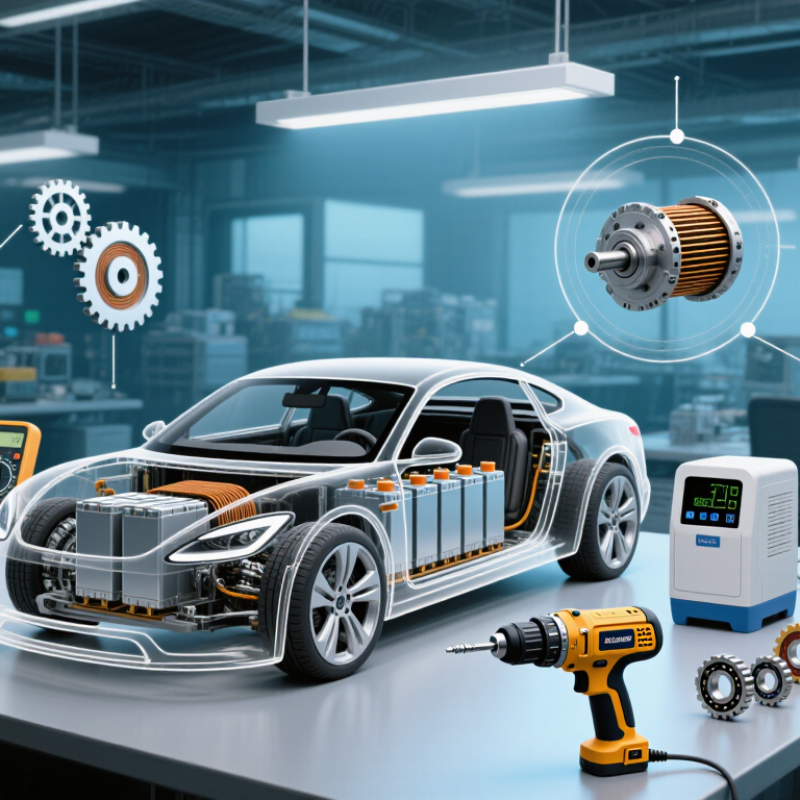
Choosing a motor for a battery-powered device starts with the device, not the catalog. Write down the required speed, torque, movement pattern, and available space. A small pump may need steady torque, while a handheld tool needs rapid acceleration. Measure the real load, including friction, startup resistance, and changing pressure. Do not rely only on nominal ratings. They can mislead.
Operating conditions determine whether a motor performs reliably beyond the workbench. Record battery voltage, discharge range, duty cycle, temperature, humidity, vibration, and noise limits. A motor inside a warm enclosure may need lower continuous loading. At low battery voltage, speed and torque can fall noticeably. Check stall duration carefully. Repeated stalls create heat quickly and may shorten service life. I have seen prototypes pass brief tests but fail after several hours. That gap deserves attention.
Tips: Test the motor with the actual battery, controller, load, and enclosure. Measure current during startup, normal operation, and overload events. Leave margin for aging, cold temperatures, and manufacturing variation. If requirements remain uncertain, build a simple test fixture before final selection. It costs less than redesigning a compact product. Still, estimates are imperfect. Review them after field trials.
Choosing a motor for a battery-powered device starts with the application, not the catalog. A small brushed DC motor suits simple toys, fans, and low-cost handheld tools. It offers easy control but may create brush wear and electrical noise. A brushless DC motor fits longer-duty products, compact pumps, and cooling systems. It usually improves efficiency, although its controller adds cost and design work. Stepper motors provide accurate positioning for valves, sliders, and small mechanisms. However, they can waste energy while holding position.
Match the motor to the battery’s voltage, current limit, and usable capacity. Measure starting current, not only the normal running value. A motor may work perfectly on a bench, then stall when a gear jams or a load increases. Geared motors deliver higher shaft torque at lower speed. This helps wheels, lifting mechanisms, and compact actuators. Check duty cycles carefully. Continuous operation needs better thermal control than short movements. I have seen designs fail because the motor fit physically, but overheated inside a sealed enclosure.
Tips: Test the complete motor, controller, battery, and load together. Record current during startup, acceleration, steady operation, and stall protection. Leave practical capacity below the battery’s theoretical rating. Noise can also matter in a bedroom device. Hall sensors may improve speed control, but they are not always necessary. When unsure, prototype two motor types. The quieter option may consume more energy, and the efficient option may feel too slow. Recheck that trade-off before finalizing the design.
| Motor Type | Typical Battery-Powered Applications | Key Operating Characteristics | Typical Efficiency Range* | Battery and Power Considerations | Control and Driver Requirements | Main Advantages | Main Limitations |
|---|---|---|---|---|---|---|---|
| Brushed DC Motor | Small pumps, toys, portable tools, fans, simple actuators, battery-powered educational devices | Continuous rotation; speed changes approximately with applied voltage; high starting torque; simple two-wire connection | 60%–85% | Simple battery connection; startup current can be several times the no-load current; allow for voltage drop and brush wear over time | On/off switch, PWM controller, or an H-bridge for reversing; no electronic commutation required | Low initial cost, simple control, easy sourcing, good short-duty-cycle performance | Brush and commutator wear, electrical noise, lower service life, reduced efficiency at small sizes |
| Brushless DC Motor (BLDC) | Portable fans, cordless power tools, drones, pumps, cooling systems, compact mobility equipment | Electronic commutation; high power-to-weight ratio; good speed control; available in sensored and sensorless configurations | 75%–92% | Works well with lithium-ion battery packs; size the battery and protection circuit for peak phase current and regenerative voltage during rapid deceleration | Requires a compatible electronic speed controller; Hall sensors improve low-speed starting and position control | High efficiency, long service life, low maintenance, quiet operation when properly controlled | Higher system complexity and cost; driver electromagnetic compatibility must be managed |
| Permanent-Magnet Synchronous Motor (PMSM) | Electric bicycles, compact electric vehicles, robotic joints, high-efficiency pumps, precision battery equipment | Synchronous operation; high torque density; smooth torque with field-oriented control; often designed for demanding duty cycles | 85%–96% | Suitable for high-energy-density battery systems; inverter and thermal design should account for continuous current, peak current, and field-weakening operation | Three-phase inverter with rotor-position feedback or advanced sensorless control; field-oriented control is commonly used | Excellent efficiency and controllability, high torque density, low acoustic noise potential | Requires sophisticated control electronics; permanent magnets can add cost and temperature constraints |
| Stepper Motor | 3D printers, camera sliders, laboratory instruments, small linear stages, valve actuators, positioning mechanisms | Moves in discrete steps; strong holding torque; precise open-loop positioning is possible; torque decreases as speed rises | 50%–80% | Can draw substantial current while stationary; battery capacity should include holding periods, not only motion time; use current limiting to reduce heat | Requires a stepper driver; microstepping improves smoothness but does not always increase absolute positioning accuracy | Accurate incremental motion, high holding torque, straightforward digital positioning | Lower efficiency during standstill, resonance risk, missed steps under excessive load or acceleration |
| Geared DC Motor | Robotic wheels, locks, blinds, small winches, adjustable seats, battery-powered mechanisms requiring high output torque | DC motor combined with a gearbox; lower output speed and higher torque; gearbox ratio determines speed, torque, and reflected inertia | 45%–80% | Battery must support high transient current during starting, stall, and load changes; include gearbox losses when estimating runtime | Simple PWM or H-bridge control; add limit switches, current sensing, or stall protection for mechanism safety | High torque from a compact package, simple control, useful for intermittent duty | Gear noise, backlash, mechanical wear, limited continuous-duty capability at high loads |
| Geared BLDC Motor | Autonomous robots, precision actuators, powered mobility systems, compact material-handling equipment | Combines efficient brushless operation with gearbox torque multiplication; supports controlled acceleration and long operating cycles | 65%–90% | Evaluate motor, controller, gearbox, and battery as one system; peak current and thermal limits may be set by the gearbox or controller rather than the motor alone | BLDC controller, position feedback when required, and closed-loop torque or speed control for demanding applications | High efficiency with increased output torque, good durability, precise controllability | More expensive and complex; gearbox backlash and lubrication requirements remain important |
| Coreless DC Motor | Portable medical instruments, miniature pumps, camera mechanisms, handheld optical equipment, compact precision actuators | Lightweight rotor with low inertia; very fast acceleration and deceleration; suitable for short response times and compact designs | 65%–85% | Low rotor inertia does not eliminate high stall current; use current limiting and thermal protection because small windings heat quickly | Simple voltage or PWM control; feedback is recommended where repeatable speed or position is important | Fast dynamic response, low inertia, compact size, low cogging torque | Limited thermal mass, comparatively delicate construction, reduced continuous high-load capability |
| Universal Motor | Portable appliances and tools that require high speed and are used for short periods | Can operate from AC or DC; high speed and high starting torque; performance varies significantly with load | 55%–75% | Generally inefficient for long battery operation; battery pack must tolerate high current and electrical noise; cooling is important | Basic switching or phase/PWM control; filtering and suppression may be required to reduce brush-generated interference | High speed, high power-to-weight ratio, strong starting torque | High noise, brush wear, electromagnetic interference, and poor suitability for long-runtime battery products |
| Switched Reluctance Motor (SRM) | High-temperature pumps, industrial mobile equipment, selected traction and ruggedized battery systems | Rotor has no permanent magnets or windings; robust construction; high-speed capability; torque is produced by controlled magnetic reluctance | 70%–90% | Can tolerate demanding environments, but battery and inverter sizing must address high phase-current ripple and possible torque pulsation | Requires a dedicated converter and rotor-position information; advanced control can reduce acoustic noise and torque ripple | Robust rotor, good high-temperature potential, reduced dependence on permanent magnets | More complex control, acoustic noise, torque ripple, and less common small-product integration |
| Linear Motor | Battery-powered precision stages, automated inspection devices, laboratory positioning systems, and direct-drive actuators | Produces linear motion directly without a rotary-to-linear transmission; fast response and low mechanical backlash | 50%–85% | Battery sizing must include acceleration energy, holding current, duty cycle, and the effect of payload position; regenerative energy may return to the DC bus | Requires a dedicated linear drive and position feedback for accurate closed-loop motion | High precision, low backlash, fast motion, fewer mechanical transmission components | Higher cost, specialized mechanical integration, and potentially high continuous holding power |
| Piezoelectric Motor | Miniature camera lenses, medical instruments, precision adjustment mechanisms, and ultra-compact positioning devices | Uses high-frequency piezoelectric vibration to create motion; compact; can provide high holding force without continuous conventional motor rotation | 30%–70% | Battery system needs a high-voltage drive stage even when the battery voltage is low; evaluate conversion losses and electromagnetic compatibility | Requires a dedicated high-frequency driver and control electronics; feedback is commonly used for precision positioning | Very small size, quiet operation, high precision, strong holding capability in some designs | Specialized driver, limited travel speed or load depending on design, sensitivity to preload and surface conditions |
Choosing a motor starts with the real load, not the advertised battery voltage. Measure the moving mass, friction, incline, and required acceleration. Torque equals force multiplied by the shaft radius. For example, a 20-newton load on a 0.05-meter pulley needs 1 newton-meter before losses. Add a practical margin of 25% to 50%. Friction is rarely as small as expected.
Speed must match the mechanism. A pulley turning at 600 revolutions per minute may move a belt too quickly. Convert the target speed into angular speed, then estimate mechanical power with P = T × ω. A 1-newton-meter load at 600 rpm needs about 63 watts mechanically. Battery demand will be higher because motor, wiring, and controller losses reduce efficiency. Check both running and startup conditions.
Voltage affects current and operating behavior. A 12-volt battery may drop below 11 volts during acceleration. Test the motor under load, not only on a workbench. I once sized a motor from steady torque and underestimated startup torque. The device moved smoothly, then stalled near a ramp. That mistake showed why peak torque, stall current, heat, and duty cycle deserve separate calculations. Leave space for imperfect measurements. Real assemblies vibrate, batteries age, and friction changes. Could the motor still work on a cold morning with a partly discharged battery?
Motor selection starts with the duty cycle, not the catalog speed. The IEA’s Global EV Outlook 2024 recorded almost 14 million electric-car sales in 2023, representing about 18% of global sales. That scale makes efficiency more than a marketing claim. The U.S. Department of Energy’s 2023 Motor Systems Market Assessment also identifies motor systems as a major share of industrial electricity use. For compact devices, measure torque, speed, load changes, and standby time. A motor with high peak efficiency may still waste energy during frequent starts.
Control quality matters. Field-oriented control can reduce ripple and improve low-speed torque, but it increases software and sensing requirements. Check current limits, encoder accuracy, startup behavior, and regenerative voltage. A controller should survive stall current without overheating. Test the real battery, wiring, and load together. Datasheet values alone can mislead.
Size the motor around continuous torque, then verify peak demand separately. Small motors save space, yet their surface area limits heat rejection. Copper loss rises with the square of current, so a brief overload can create surprising heat. Use a thermocouple near the winding and test inside the actual enclosure. IEC 60034-30-1 offers useful efficiency-class references, although many small battery motors fall outside its scope. That limitation deserves attention. I would not trust a single room-temperature test; airflow, dust, mounting material, and battery voltage all change thermal performance.
2026 Top Guide: How to Choose Motors for Battery Powered Devices?
Choosing a motor for a battery-powered device starts with the workload, not the catalog price. In field testing, a motor that survives brief peaks may fail under repeated starts. Brushed DC motors usually cost less and use simple drivers. Their brushes wear, especially with dust, vibration, and long daily cycles. That makes maintenance predictable, but not negligible. Brush replacement also needs access space. It matters.
Brushless DC motors often provide better efficiency and longer service intervals. They need electronic commutation, which raises controller cost and design complexity. For sealed tools or continuous-duty equipment, that trade can improve reliability. A geared motor delivers useful torque from a small battery. However, gears add noise, backlash, and lubrication concerns. Stepper motors offer precise positioning, yet they can draw current while holding still. That wastes energy in portable products. Check actual current at the target load, not only the rated value.
A practical comparison should measure startup current, temperature, noise, speed, and runtime with the real battery. Test a dusty enclosure and a partly discharged battery pack. These conditions expose weak choices quickly. Engineers should inspect bearings, shaft seals, connectors, and controller heat paths. A cheaper motor can become expensive after repeated service visits. Still, premium efficiency is not automatically economical. If the device runs two minutes daily, purchase cost may matter more. I have seen designs overpay for efficiency they rarely used. That mistake is easy to repeat.
Comparison of common motor options by efficiency, typical service life, and relative upfront cost.
BLDC and PMSM motors generally provide the best efficiency and longest maintenance-free service life because they avoid brush wear. Brushed DC motors usually have the lowest initial cost but require more maintenance. Stepper motors offer precise positioning, although their efficiency can be lower when holding torque is required. Service-life values are representative engineering midpoints and depend on load, speed, temperature, bearings, and operating duty cycle. The cost index uses the brushed DC motor as a relative baseline of 100.
Start with the real application and load. A small brushed motor suits toys, fans, and simple handheld tools. A brushless motor fits pumps, cooling systems, and longer-duty products. A stepper motor suits valves, sliders, and accurate positioning. Each choice has compromises.
Match the motor to battery voltage, current limits, and usable capacity. Measure starting current, not only normal running current. A 12-volt battery may fall below 11 volts during acceleration. Leave capacity below the theoretical rating. Batteries age.
Torque equals force multiplied by shaft radius. A 20-newton load on a 0.05-meter pulley needs 1 newton-meter before losses. Add a practical margin of 25% to 50%. Friction, vibration, and alignment can increase the real requirement. Bench estimates may be too optimistic.
Match motor speed to the complete mechanism. A pulley turning at 600 revolutions per minute may move a belt too quickly. Estimate mechanical power using torque multiplied by angular speed. A 1-newton-meter load at 600 rpm needs about 63 watts mechanically. Battery power will be higher because losses occur.
Motors draw high current during startup, acceleration, and stalled movement. A gear jam can push current far above the normal running value. Record current during startup, steady operation, and stall protection. I once sized a motor from steady torque and underestimated startup demand. That design stalled near a ramp.
Continuous operation needs stronger thermal control than short movements. A sealed enclosure can trap heat around the windings. Use a temperature sensor near the winding during realistic testing. Check airflow, dust, mounting materials, and ambient temperature. One room-temperature test is not enough.
Controllers must handle current limits, startup behavior, and possible regenerative voltage. Position sensors can improve speed control, but they are not always necessary. Advanced control may reduce ripple and improve low-speed torque. It also adds software, sensors, cost, and design work. More control is not automatically better.
Test the motor, controller, battery, wiring, and load together. Small motors save space but reject heat poorly. Copper loss rises with the square of current. A quiet motor may consume more energy, while an efficient motor may feel too slow. That trade-off matters. Prototype two options when uncertain.
Choosing the right motor is essential for achieving reliable performance, long battery life, and safe operation in portable equipment. This guide explains how to choose motors for battery powered devices by first defining the device’s workload, operating environment, duty cycle, noise limits, and available battery voltage. It then compares suitable motor types according to the application, considering factors such as starting requirements, controllability, load characteristics, and expected operating time.
The selection process also includes calculating the required voltage, torque, speed, and power, while allowing sufficient margin for startup and changing loads. Efficiency, electronic controls, physical size, weight, heat generation, and cooling must be evaluated together because each affects battery consumption and service life. Finally, motor options should be compared based on reliability, total cost, maintenance needs, and compatibility with the overall system. A balanced decision will provide consistent output, efficient energy use, manageable temperatures, and dependable long-term operation.

KPM Minimoto